If you’ve ever built an app, called an API, or even just poked around a website’s network tab, you’ve probably run into this question: Should you use XML or JSON? It sounds like a small technical detail, but this decision quietly shapes how fast your app runs, how easy your code is to maintain, and even how secure your data stays.
In 2026, the debate isn’t as heated as it was a decade ago — JSON has clearly become the default choice for most modern APIs — but XML hasn’t disappeared either. Large enterprises, government systems, and industries such as finance and healthcare still rely on XML for specific reasons. So instead of picking a “winner” blindly, let’s break down exactly where each format shines, where it struggles, and which one actually makes sense for your project.
By the end of this guide, you’ll know exactly which format to choose — and why.
What Are XML and JSON, Really?
Before comparing them, let’s quickly define both.
XML (eXtensible Markup Language) is a markup language, similar in spirit to HTML, that wraps data inside custom tags. It was designed to be both human- and machine-readable, and it became the backbone of early web services, such as SOAP APIs.
<user>
  <name>Ali Khan</name>
  <age>27</age>
  <city>Rawalpindi</city>
</user>
JSON (JavaScript Object Notation) is a lightweight data-interchange format built around key-value pairs. It was popularized by Douglas Crockford in the early 2000s and has since become the de facto standard for web and mobile APIs.
{
  "name": "Ali Khan",
  "age": 27,
  "city": "Rawalpindi"
}
Notice how much shorter the JSON version is? That single difference — payload size — is one of the biggest reasons JSON dominates modern API design.
Why This Comparison Still Matters in 2026
You might be wondering: hasn’t this debate already been settled? Not entirely. While JSON vs. XML for APIs has largely tilted toward JSON, XML remains deeply embedded in legacy enterprise systems, financial transaction protocols (such as SWIFT and FIX), and industries bound by strict schema validation requirements. Developers migrating old systems, working with government data, or maintaining backward compatibility still need to understand XML deeply.
So the real question in 2026 isn’t “which format is objectively better” — it’s “which format is better for your specific use case.”
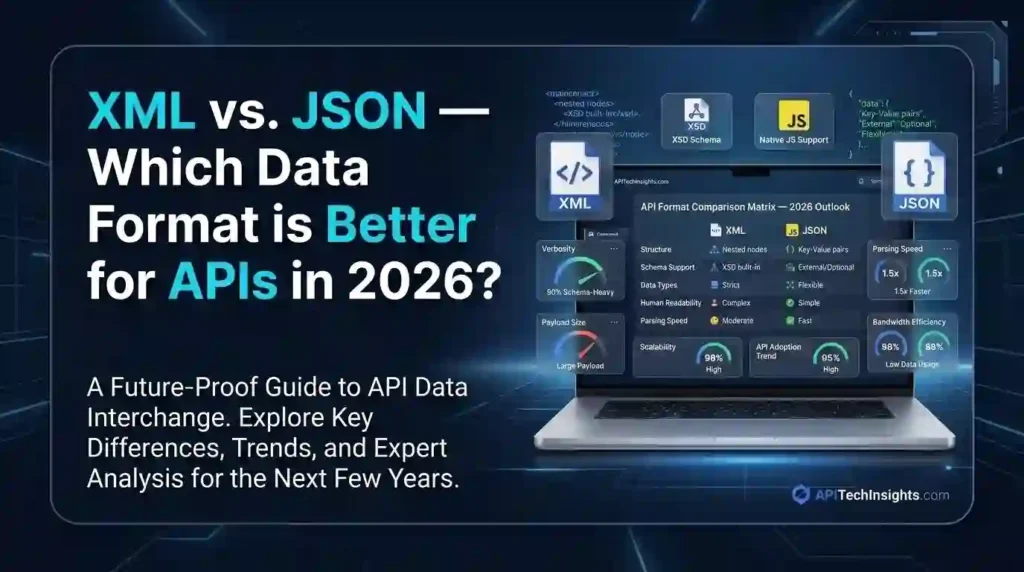
XML vs JSON: Quick Comparison Table
| Feature | XML | JSON |
|---|---|---|
| Readability | Verbose, harder to scan | Clean, easy to read |
| Payload size | Larger (more markup overhead) | Smaller, more compact |
| Parsing speed | Slower | Faster |
| Data types | Text-only (strings) | Supports strings, numbers, booleans, arrays, objects |
| Schema validation | XML Schema (XSD) — very strict | JSON Schema — flexible |
| Namespaces | Supported | Not applicable |
| Security | Vulnerable to XXE if misconfigured | Generally safer, no external entity risk |
| Best for | Enterprise systems, documents, SOAP APIs | REST APIs, mobile apps, web services |
| Browser/JS support | Requires parsing libraries | Native JavaScript support |
JSON vs XML for APIs: The Core Differences
1. Readability and Simplicity
JSON’s structure mirrors how developers already think in most programming languages — objects, arrays, and key-value pairs. This human-readable data format reduces cognitive load when debugging or reading API responses. XML, by comparison, requires opening and closing tags for every single element, which adds visual clutter, especially in deeply nested data structures.
2. Payload Size and Bandwidth
Because XML needs matching open/close tags for every node, the payload size and bandwidth cost is noticeably higher — often 30–40% larger than the equivalent JSON payload. For mobile app APIs and IoT data exchange, where every kilobyte affects load time and battery life, this difference adds up fast.
3. API Parsing Speed
JSON parsing is typically faster because most modern languages have native or highly optimized JSON parsers built in (JavaScript, Python, Java, PHP—all include them out of the box). XML parsing, especially with DOM-based parsers, is often more resource-intensive, directly affecting API response times at scale.
4. Data Type Support
This is an underrated point. JSON natively supports arrays and object notation, along with primitive data types like numbers and booleans. XML treats everything as text by default, meaning your code has to manually convert values — adding extra steps and potential bugs.
5. Schema Validation
Here’s where XML actually has an edge. XML Schema (XSD) offers very strict, mature validation rules — useful in industries where data integrity is non-negotiable, such as healthcare (HL7) and banking. JSON Schema also exists and has matured significantly, but it’s generally more flexible and less rigid by design.
6. Security Considerations
API security is a major factor in 2026. XML has a known vulnerability called XXE (XML External Entity) injection, which, if the parser isn’t configured correctly, can expose internal files or systems. JSON doesn’t have this specific vulnerability, making it inherently a bit safer by default — though of course, no format is immune to poor implementation.
7. Namespaces and Attributes vs Elements
XML supports namespaces, allowing you to mix vocabularies from different sources without name collisions — something JSON simply doesn’t need because APIs are typically scoped. XML also distinguishes between attributes and elements, giving you more structural flexibility, but also more decisions to make.
When Should You Use XML Instead of JSON?
Despite JSON’s dominance, there are still solid reasons to reach for XML in 2026:
- Legacy enterprise systems — Many banking, insurance, and government platforms were built on SOAP APIs and haven’t migrated.
- Strict document validation — Industries needing guaranteed structure (like HL7 healthcare records) rely on XSD.
- Complex documents with mixed content — Think publishing formats or documents that blend text and markup (like DocBook).
- SOAP-based integrations — Some enterprise middleware still requires SOAP, which is XML-based by design.
If you’re not in one of these categories, JSON is very likely your better option.
Why JSON Is Preferred for Modern APIs
Most REST APIs, GraphQL data format implementations, and mobile app APIs default to JSON today because of:
- Native compatibility with JavaScript and AJAX-based web services
- Smaller payloads, meaning faster API response times
- Easier integration with JWT (JSON Web Tokens) for authentication
- Broad support across the OpenAPI Specification and Swagger documentation
- Simpler onboarding for new developers
Even API documentation tools like Swagger/OpenAPI are built primarily around JSON, reinforcing its position as the industry standard for REST APIs.
What About Alternatives Like YAML and Protocol Buffers?
It’s worth knowing that JSON and XML aren’t the only players. YAML vs. JSON comes up a lot in configuration files (e.g., Docker, Kubernetes) because YAML is even more human-readable. Meanwhile, Protocol Buffers (protobuf) and MessagePack are gaining traction in high-performance internal microservices architectures, where binary formats outperform both JSON and XML in raw speed. If you’re scaling a system in 2026, it’s worth knowing these exist — though for public-facing APIs, JSON remains the safest, most universally supported choice.
Performance Benchmark Snapshot
While exact numbers vary by implementation, general industry benchmarks consistently show:
- JSON payloads are typically 20–40% smaller than equivalent XML payloads.
- JSON parsing is often 2–3x faster than XML parsing in JavaScript environments.
- XML’s schema validation (XSD) remains more feature-rich for complex enterprise rule enforcement.
These numbers explain why API scalability discussions in 2026 almost always favor JSON for high-traffic, public REST APIs.
Converting Between XML and JSON
In real-world development, you’ll often need both formats to communicate — especially when integrating a modern app with a legacy XML-based system. If you’re dealing with this regularly, it’s worth using a dedicated JSON-to-XML converter to handle the transformation instantly, without writing custom parsing scripts. We’ve also put together a detailed JSON to XML conversion guide and a broader data conversion guide covering JSON, XML, and CSV if you want to understand the full picture of moving data between formats.
FAQs About XML vs JSON
What is the difference between XML and JSON? XML is a markup language that uses nested tags to structure data, while JSON is a lightweight format built on key-value pairs. JSON is generally more compact and faster to parse, while XML offers stronger schema validation and namespace support.
Is JSON faster than XML? Yes, in most cases. JSON’s simpler structure and native parsing support in languages like JavaScript make it faster to read, write, and transmit compared to XML.
Why do most modern APIs use JSON instead of XML? Modern APIs favor JSON for its smaller payload size, native compatibility with JavaScript, faster parsing, and simpler integration with REST and GraphQL architectures.
Is XML dead in 2026? No. XML is still actively used in enterprise systems, SOAP-based APIs, healthcare data exchange (HL7), and government platforms, though it’s no longer the default choice for new public APIs.
Can XML and JSON be used together? Yes. Many systems convert between the two formats when integrating legacy XML-based services with modern JSON-based applications, often using automated conversion tools.
Which format is more secure, XML or JSON? JSON is generally considered safer by default since it doesn’t have XML’s XXE (External Entity) vulnerability. However, both formats can be properly secured with the correct parser configuration and validation.
Which Should You Choose in 2026?
If you’re building a new REST API, a mobile app backend, or anything web-facing, JSON is almost always the better choice. It’s lighter, faster, easier to work with, and has become the unspoken standard across the developer ecosystem.
If you’re maintaining or integrating with legacy enterprise systems, working in industries with strict compliance and schema requirements, or dealing with SOAP-based services, XML still holds its ground and isn’t going anywhere soon.
The smartest developers in 2026 aren’t loyal to one format — they know both, and they choose based on the job at hand.
Final Thoughts
Choosing between XML and JSON isn’t really about which format is “better” in some absolute sense — it’s about matching the tool to the task. JSON wins on speed, size, and simplicity for most modern APIs. XML wins on strict validation and legacy compatibility. Understanding both gives you the flexibility to work confidently across old and new systems alike.
If you regularly work with structured data and need to move between formats without wrestling with code, explore our free JSON to XML Converter and check out more tools on our free tools page to simplify your workflow. New to online conversion tools in general? Our beginner’s guide to Free Convertors is a great place to start, and if you’re curious how browser-based tools stack up against installed software, take a look at our comparison of browser-based tools vs desktop software.
For deeper technical reference, the official JSON specification and the W3C XML standard are excellent authoritative resources worth bookmarking.
Ready to simplify your data workflow? Try our free JSON-to-XML converter today and stop wasting time on manual formatting — it takes seconds, works right in your browser, and requires no sign-up.