If you’re one of the many Pakistani workers building a career in the UAE, converting your salary from AED to PKR is probably something you do mentally every single payday. How much is this in rupees back home? Is today a good day to send money, or should I wait? This guide walks through everything you actually need to know about the PKR-to-AED relationship — how the rate moves, the smartest ways to send money home, and how to avoid quietly losing money to unnecessary fees.
One thing to flag upfront: exchange rates change by the hour, sometimes by the minute. Rather than quoting you a number that’ll be outdated by the time you read this, we’ll show you how to check the current rate reliably and how to think about timing, which matters far more than memorizing today’s figure.
Understanding PKR to AED: The Basics
The Pakistani Rupee (PKR) and the UAE Dirham (AED) are two of the most actively traded currency pairs in the Gulf region, given the large number of Pakistani workers employed across the UAE — in construction, healthcare, IT, hospitality, and domestic work. As of recent data, 1 AED has generally traded between 75 and 77 PKR, though this fluctuates constantly based on global currency markets, so always check a live source before making any financial decision.
For a quick, accurate, up-to-the-minute conversion, it’s worth bookmarking a reliable currency converter rather than relying on a number you saw somewhere last week.
Why the PKR to AED Rate Keeps Changing
If you’ve ever wondered why the number you see on Monday is different from what your friend mentioned on Friday, here’s what’s actually driving that:
- Interbank rate vs. open market rate: The interbank rate is what banks use to trade with each other, while the open market rate — the one you’ll typically get at an exchange house — includes a markup. These two numbers are rarely identical.
- State Bank of Pakistan policy: SBP’s monetary policy decisions, foreign reserve levels, and intervention in currency markets all affect PKR’s value.
- UAE Dirham’s peg to the US Dollar: The AED is pegged to the USD, meaning AED-to-PKR movement is largely driven by how PKR performs against the USD more broadly.
- Remittance flow volume: Higher remittance inflows from Gulf countries can affect short-term rate stability.
- Global oil prices and regional economic conditions: Since the UAE’s economy is closely tied to oil markets, broader shifts here can ripple into currency valuations.
None of this requires you to become a forex expert — but understanding that the rate moves for real economic reasons (not randomly) helps you avoid panic-checking it five times a day.
How to Convert Your Salary from AED to PKR
If you’re trying to budget or plan how much to send home, the math itself is simple once you have the current rate:
AED amount × current AED-to-PKR rate = PKR value
For example, if the rate is 76 and your monthly salary is AED 4,000, that’s roughly PKR 304,000 before any transfer fees. The tricky part isn’t the math — it’s knowing which rate to use, since the rate your bank or exchange app actually gives you when transferring is usually slightly different (and slightly worse) than the “mid-market” rate you see on Google. This is one of the most common points of confusion for expats, and it’s worth understanding before you send a large amount for the first time.
Best Ways to Send Money from the UAE to Pakistan
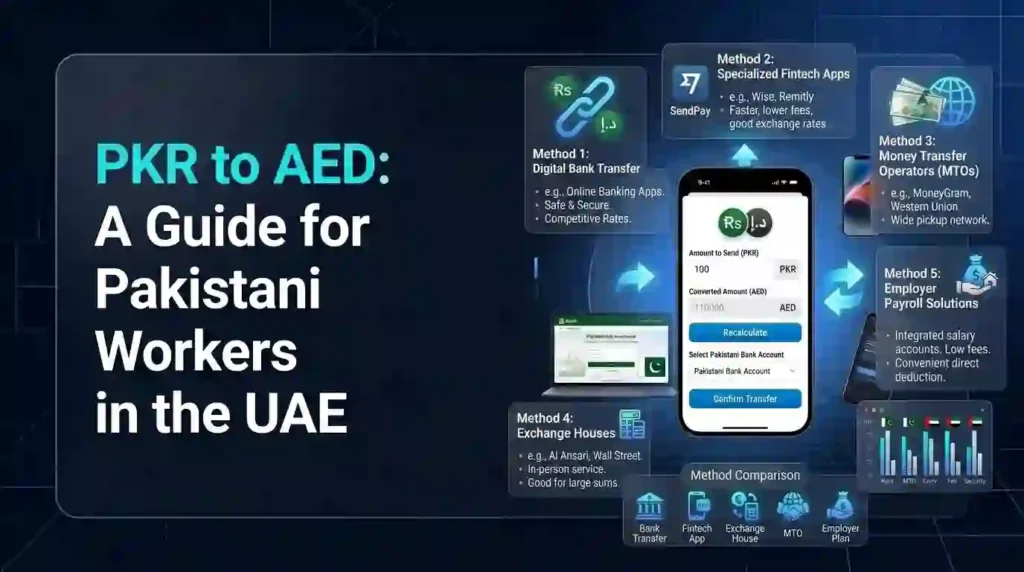
Not all transfer methods are created equal, and the difference between them can genuinely cost you thousands of rupees over a year. Here’s a practical comparison:
Bank Transfers
Traditional bank-to-bank transfers (via SWIFT) tend to be reliable but often incur higher fees, offer less competitive exchange rates, and have longer processing times — sometimes 2-5 business days.
Exchange Houses
UAE-based exchange houses (like Al Ansari Exchange, Lulu Exchange, or Wall Street Exchange) are extremely popular among the Pakistani community for a reason: they’re fast, often same-day, and rates are generally competitive, especially for cash pickup services in Pakistan.
Remittance Apps and Fintech Platforms
Digital-first services have grown significantly in popularity because they typically show the fee upfront, use closer-to-mid-market rates, and let you track transfers in real time. For workers who want transparency without visiting a physical branch, this route has become increasingly common.
Roshan Digital Account
For overseas Pakistanis specifically, the Roshan Digital Account (RDA) — introduced by the State Bank of Pakistan — offers a way to manage banking, investments, and remittances back home directly, often with attractive terms for non-resident Pakistanis.
How to Avoid Losing Money on Transfer Fees
This is where most people unknowingly lose value, so it’s worth being deliberate about:
- Compare the amount actually received, not just the fee. A “zero fee” transfer with a poor exchange rate can cost you more than a transfer with a small fee but a better rate.
- Avoid airport or hotel exchange counters. These almost always offer the worst rates, reserved for genuine emergencies only.
- Time larger transfers when possible. If you’re sending a significant amount and rates are unusually favorable, it can make sense to send a bit earlier or hold off a few days — though chasing tiny fluctuations for small amounts usually isn’t worth the mental effort.
- Consolidate transfers where practical. Sending one larger transfer monthly, rather than several smaller ones, often reduces the cumulative impact of fixed fees.
Salary Planning for Pakistani Workers in the UAE
Budgeting across two currencies takes a bit of extra planning. A structure that works well for many workers:
- Fixed monthly remittance: Decide on a consistent amount to send home each month, based on your family’s needs, rather than reacting to daily rate swings.
- UAE living costs buffer: Housing, transport, and daily expenses in the UAE can vary significantly by emirate — Dubai and Abu Dhabi tend to run higher than Sharjah or Ajman.
- Emergency savings in AED: Keeping a small buffer in your UAE account helps you avoid converting money back from PKR to AED at a poor rate in an emergency.
- Periodic rate check-ins: Rather than watching the rate daily, checking in weekly is usually sufficient for planning purposes, using a dependable currency converter tool.
If you’re coordinating time-sensitive transfers or calls with family back home, it also helps to know the time difference — the UAE is generally ahead of Pakistan by a small margin depending on daylight saving conventions, and this guide to time zone differences between Pakistan, UAE, UK, and USA can help you plan calls or transfer windows around when banks and exchange houses are actually open on both ends.
Common Mistakes Pakistani Workers Make with Remittances
- Not comparing providers before a large transfer. Even a 1-2% difference in rate matters significantly on larger sums.
- Ignoring receiving-end fees. Some banks in Pakistan charge a small fee for receiving international transfers — worth checking with the receiving account holder.
- Sending cash through informal channels. Beyond legal risk, informal transfer methods offer no protection if something goes wrong.
- Not keeping transfer records. Documentation matters for both personal budgeting and, in some cases, tax or remittance certificate purposes back in Pakistan.
A Note on Remittances and Pakistan’s Economy
Worker remittances from the Gulf, including the UAE, are among the largest and most consistent sources of foreign exchange for Pakistan, playing a genuinely significant role in the country’s balance of payments. This is part of why the government has actively promoted formal banking channels like Roshan Digital Accounts over informal transfer methods — formal channels are traceable, safer, and more directly support the broader economy. For official guidance and current regulations on remittances, the State Bank of Pakistan remains the most authoritative resource.
Frequently Asked Questions
What is the current PKR-to-AED exchange rate? The rate fluctuates continuously, generally trading in the range of 75-77 PKR per 1 AED in recent periods. For an accurate, real-time figure, check a live currency converter rather than relying on a fixed number.
What is the cheapest way to send money from the UAE to Pakistan? This varies by provider and changes over time, but exchange houses and digital remittance platforms generally offer more competitive rates and lower fees than traditional bank wire transfers or airport counters.
Why does the PKR-to-AED rate change so often? Currency rates respond to interest rate policy, foreign reserve levels, remittance flow volumes, and the AED’s peg to the US Dollar, among other economic factors — it’s a constantly moving market rather than a fixed number.
Is a bank transfer or an exchange house better for sending money to Pakistan? Exchange houses often offer faster processing and more competitive rates for cash pickup, while bank transfers may suit those who prefer direct account-to-account transfers, though they typically have longer processing times.
How can Pakistani workers in the UAE get the best exchange rate? Compare multiple providers before large transfers, avoid airport/hotel exchange counters, and check rates using a reliable converter rather than assuming any single provider always offers the best deal.
Do remittance apps charge hidden fees? Reputable apps are generally required to disclose fees upfront, but it’s still worth comparing the final amount received across providers, since exchange rate margins can serve as a hidden cost even when the stated “fee” is low.
Final Thoughts
Managing money across PKR and AED doesn’t have to be stressful once you understand what actually drives the rate and which transfer methods genuinely serve you best. The goal isn’t to obsessively track every rate movement — it’s to build a simple, consistent system: check a reliable source before transfers, compare providers periodically, and avoid the common fee traps that quietly cost workers real money every year.
For quick, accurate conversions whenever you need them, try our free currency converter, and if you’re also managing business-related currency needs alongside personal remittances, this guide on currency converter tools for small businesses is worth a look too. Explore more free tools at Free Convertors to make managing money across borders simpler, no matter what currency you’re working with.